

- 2 Days – Orientation
- 8 days – Professional Development Workshop for teachers
- 8 days – School Based Support (2 rounds, with 4 days each for a batch of 20 teachers

The Power of Connections: How Interdisciplinary Teaching Transforms Learning
04
Aug
Posted by: Rashmi Sethuram
Category:
Creating Empowered Classrooms
No Comments

It all began with a single, hesitant question from one of my students: “But ma’am, is it really a Dark Continent? (an unexplored , unknown and mysterious land for many European travellers in the historical context) And why does it matter?
While teaching a unit on Africa’s geography in Social Studies, I noticed some students losing interest – eyes wandering, hands fidgeting. As a teacher, few things feel more disheartening than seeing that spark fade.
And then it struck me – what if I connected this lesson to something they could relate to or they cared about?
“Imagine a new classmate from Kenya joins your class. They share stories about their home, school, and favorite foods. What’s one question you would ask them to understand their culture better? Now, let’s talk about Africa again.”
Suddenly, the class lit up – students leaned in, asked questions, and the lesson evolved into a rich discussion spanning geography, history, economics and poetry. We explored Africa as the “cradle of humankind,” staple crops and even heard a poem on its beauty.
This was when I realized interdisciplinary teaching isn’t just about combining content. It’s about making learning meaningful by helping students connect ideas, see patterns and view the world more deeply and thoughtfully.
What Is Interdisciplinary Teaching?
Interdisciplinary teaching blends concepts and skills from multiple subjects to give students a well-rounded understanding of a topic. It breaks down traditional boundaries between subjects like Science, History, and Math, highlighting how knowledge intersects and applies in real life.
Some benefits of Interdisciplinary Teaching:
An interdisciplinary approach in education offers numerous benefits, including fostering critical thinking, promoting innovation and encouraging synthesis of knowledge across different disciplines.
 How I Made My Classroom Interdisciplinary
I started experimenting with interdisciplinary teaching after that transformative moment in the Social Studies class. Here are a few strategies I used:
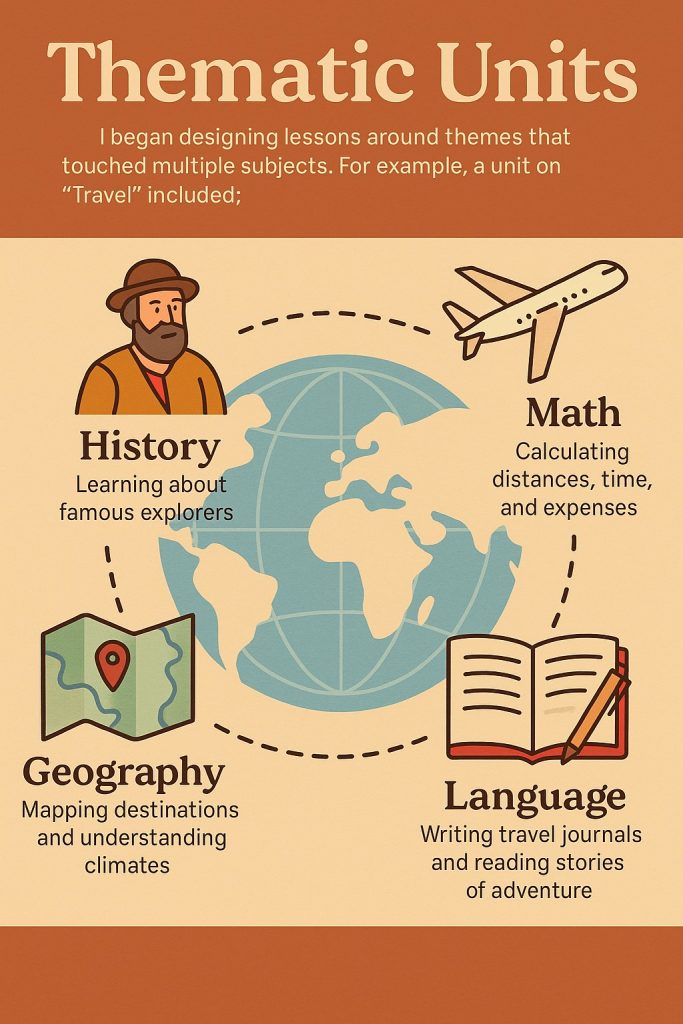
1. Thematic Units: I began designing lessons around themes that linked multiple subjects, helping students see meaningful connections and engage more deeply.This made learning feel like a journey, rather than a series of isolated lessons.
 2. Storytelling and Role-Play: When teaching the concept of trade, I turned my classroom into an ancient marketplace. Students took on roles as traders from different civilizations – Silk from China, Spices from India, Gold from Egypt. They negotiated, bartered, and understood how trade shaped cultures and economies. This blend of history, geography and drama helped students feel the learning, not just hear it.
3. Problem-Based Learning: I presented real-world problems that required knowledge from multiple subjects to solve. For example, students were tasked with designing a sustainable city. They used:
• Science to understand clean energy and pollution control
• Math to budget their city expenses
• Social Studies to consider the social structure and laws
• Visual Arts: Creating models and drawings of their city designs to bring their ideas to life and showcase their creativity
4. Collaboration with Other Teachers: One of my most rewarding experiences was collaborating with the Art and English teachers for a project on “Environmental Awareness.” Students painted murals depicting environmental issues and then wrote poetry expressing their thoughts.
The Challenges I Faced (And Overcame)
Of course, the journey wasn’t without challenges. Initially, it was difficult to break free from the traditional structure of subject periods. I also had to spend extra time planning integrated lessons. But I learned to:
• Start small, with one or two interdisciplinary lessons a month
• Collaborate with other teachers to share the planning load
Final Thoughts: The Beauty of Connected Learning
The true beauty of interdisciplinary teaching is that it mirrors the real world – a world where ideas, problems, and solutions are all connected.
That day in the class, when I turned to the continent of Africa, I wasn’t just teaching Social Studies. I was teaching empathy, history and problem-solving. I was teaching my students to think beyond textbooks, to connect knowledge and make it their own.
So, the next time your students ask, “But why does this matter?” – remember, it’s an opportunity. An opportunity to show them the world beyond the classroom, where all knowledge is interconnected.
Nidhi Soni
Centre Head, Mumbai
The Teacher Foundation