

- 2 Days – Orientation
- 8 days – Professional Development Workshop for teachers
- 8 days – School Based Support (2 rounds, with 4 days each for a batch of 20 teachers

The Power of Feedback
05
Sep
Posted by: Rashmi Sethuram
Category:
The Power of.....
No Comments

“When people are trying to learn new skills, they must get some information that tells them whether or not they are doing the right thing”. This line captures the essence of what feedback is. It is so important for a learner to know whether they are on the right path – along with an idea of where they need to reach and how they need to get there. Hence, feedback that a learner receives, plays an important role in the teaching-learning process.
Back in 2018 when I was an Assistant School Leader, one of my primary roles was to mentor the mathematics and science teachers. This was when I started to research a lot more and spoke to people about what feedback is, why it is important and how it needs to be given. There was a drastic shift in perspective – it was that feedback (although a noun) is not something that is “given” to the other person. It is the process of feedback and the transaction between the mentor and mentee that makes all the difference. This made me look at feedback as a verb, as a process.
I will be talking about a few of my key learnings about the process of feedback in the rest of this article. Although these learnings stem from my interaction with teachers, the same principles are applicable to teacher-student feedback as well.
- Ask Questions: More often than not, when it comes to “giving” feedback, it is handed down as either advice or a prescription – do this, do that. When the same is posed as a question – what do you think can be done? How can this be improved? How do you feel about your work? – it invites collaboration. Questions make the process of feedback a two way street. It allows for the receiver to think deeply about various aspects of their work and how it can be improved. It also helps to ask questions about how the the receiver felt about doing something as it is important to understand the emotional response to a task/activity.
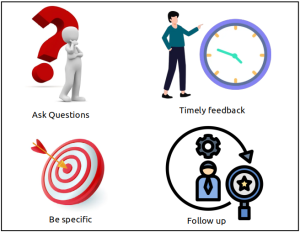
- The sooner, the better: It often happens that we wait until an official conversation or put away feedback for a later time. When the conversation is delayed, the event is not very fresh in our minds. It can sometimes become a little pointless to talk about it later and we also miss the chance of realising patterns sooner. Therefore, it is crucial that the feedback conversations occur promptly.
- Be specific with appreciation: After reading about Carol Dweck and her concept of the growth mindset, I came to realise that more than being critical, appreciation is an important aspect of the process of feedback. Furthermore, the appreciation should be specific and refer to the effort one has put in, rather than the final outcome. For example, saying “good job” or “excellent” are not only vague, they also appreciate just the final product. Instead, saying “I see how you have neatly written the number carried over under the tens place” or “I like the colour combinations you have chosen, they bring out the contrasts well” is specific and it appreciates the effort and/or attention to detail.
- Follow up: This is one of the most important aspects of the process of feedback. It is extremely important to put down learning from the conversation and what possible next steps should be. Since the process of feedback is cyclic, these next steps should be revisited in the following conversations to check if learning from the earlier conversations are implemented. This is also space for accountability as it holds the student responsible for their work as well as ensuring that there is an improvement in the work.
In conclusion, the power is in the process of feedback and it is an iterative process. The relationship between the giver and the receiver is also an important factor in this process. Timely feedback, where there is room for a lot of questions to be asked, finding areas on which one can be appreciated for their effort and consistently following up will ensure that feedback is understood by the receiver and they have something concrete to act upon to improve their work.
Soorya Hariharan
Sr Coordinator, Training and School Support
The Teacher Foundation