

- 2 Days – Orientation
- 8 days – Professional Development Workshop for teachers
- 8 days – School Based Support (2 rounds, with 4 days each for a batch of 20 teachers

The Role of Student Voice in Classrooms
10
Jun
Posted by: Rashmi Sethuram
Category:
Creating Empowered Classrooms
No Comments

“Our job is to create rooms filled with students’ voices, not be the main voice.”
– Pernille Ripp
When I read this quote, I instantly visualise walking into a classroom where students aren’t just answering questions – they are asking them, debating them and shaping the inquiry agenda. The energy is incredible, almost magnetic. I find myself wanting to join their group.
Perhaps, this is the power of realising that one’s voice matters.
Creating Space for Voice: Shifting Roles in the Classroom
When thinking about actively engaging learners, to me, student voice emerges as an integral component of the process. In essence, student voice is much more than students speaking up. It involves providing space and opportunities for them to express their choices, interests, concerns and perspectives within a setting. It is imperative to help them see the power of their voice, enabling their expressions to be both authentic and specific.
In classrooms where student voice is promoted, I notice a significant departure from the traditional hierarchical structure where the teacher does most of the talking. There is a shift towards a more democratic and equitable environment. Students are seen not just passively absorbing information, but becoming active members of the construction of learning.
Questions that Open Doors to Student Voice
Here are a few examples of questions that I have used in my teaching practice and have also seen educators use to invite student voice –
- How would you like to showcase your understanding?
- What is one thing you found hard in this project?
- Is there an alternative way to approach this scenario?
- How well do you think you contributed to the group task?
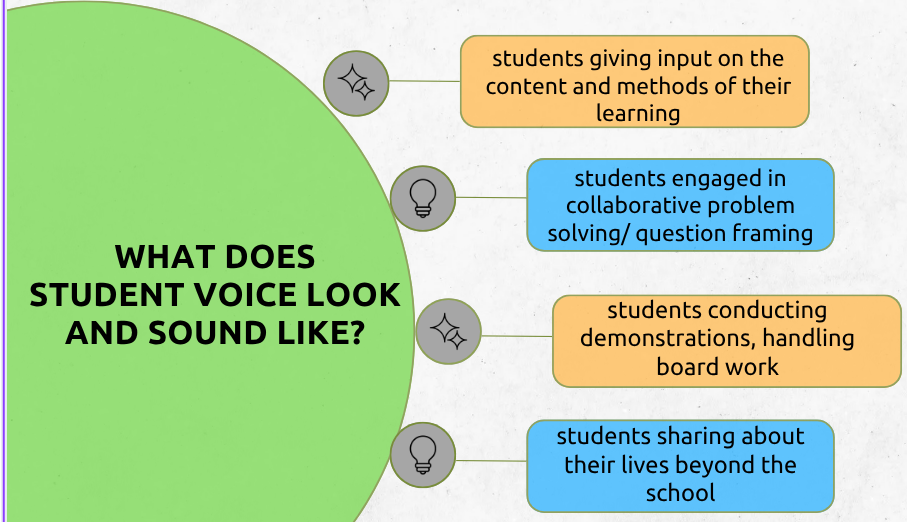
Student voice, when nurtured intentionally, often looks and sounds like this:
 Why Student Voice Matters
A 2016 research conducted at Quaglia Institute for Student Aspirations indicates that students who believe they have a voice in school are seven times more likely to be academically motivated than students who do not believe they have a voice.
This research highlights the wide- ranging benefits of student voice like:
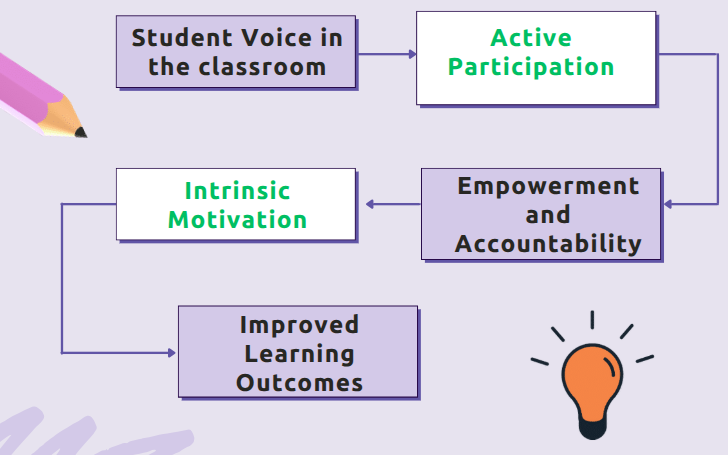
- engages and empowers students
- encourages independent thinking and analytical skills
- fosters a sense of belonging and community
- promotes ownership and accountability in learning
The Impact of Student Voice
When students’ voices are heard and valued, the results are far- reaching. The classroom environment becomes responsive, collaborative and energetic. Learners begin to see themselves as contributors to the learning process and environment, which in turn enhances trust between them and the teacher. As teachers, we know that one of the best ways to prevent behavioural issues in the classroom is to deeply engage students in learning. Hence, creating opportunities for student voice is an effective way to design classroom environments that deeply engage students in learning while minimising disturbances.
After all, when students feel heard, the classroom begins to feel like theirs – a space where they belong, contribute and grow!